

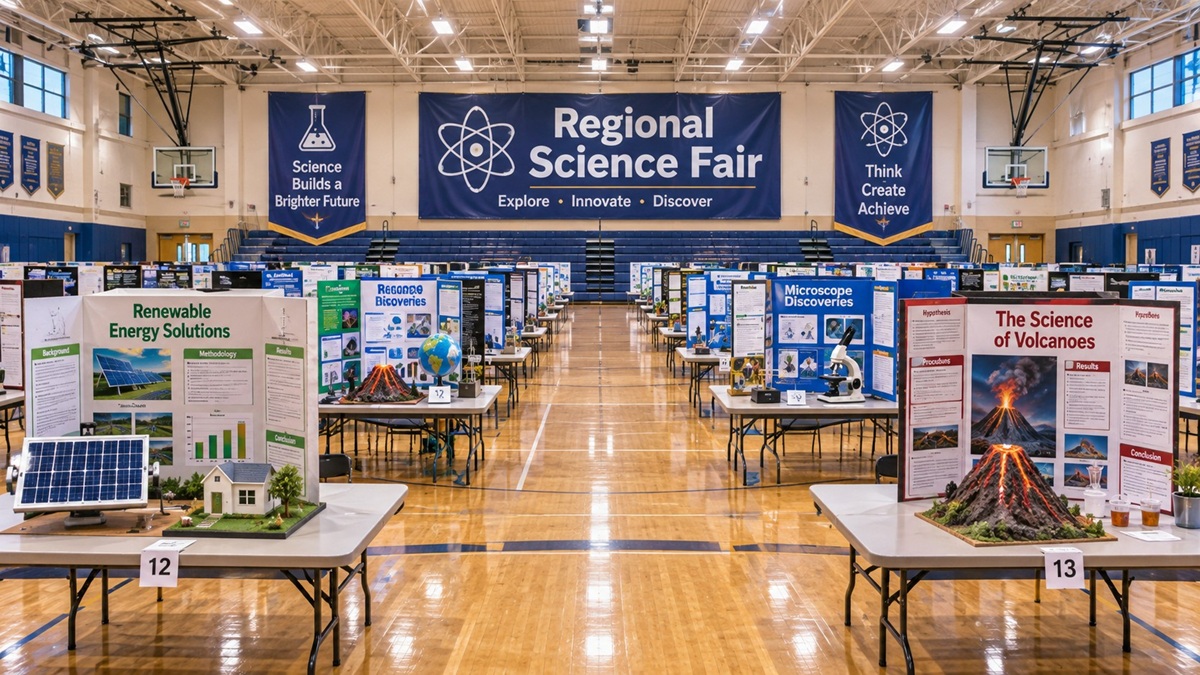
When most high school students hear the phrase “science fair,” they picture tri-fold poster boards in a crowded gymnasium, mandatory middle school homework assignments, or simple classroom demonstrations like baking soda volcanoes. What many students do not realize is that behind these local school events lies a massive global system of science fairs and research competitions. Participating in this broader ecosystem gives students the chance to conduct original research, win major college scholarships, gain national recognition, and build academic credentials for selective university admissions.
Unfortunately, access to these opportunities remains unequal. Students attending under-resourced schools, homeschooled students, first-generation applicants, and those without connections to university laboratories often assume that high-level scientific research is out of reach. Many believe they cannot compete unless their school organizes a science fair, or that they need expensive laboratory equipment and a university professor as a mentor.
These assumptions are incorrect. Understanding how to find, enter, and succeed in pre-collegiate research competitions is part of navigating the “unwritten rules” of education. This article uncovers these invisible pathways, explains how the competition system works, and provides a realistic roadmap for high school students to pursue scientific research regardless of their school’s resources.
This guide builds directly on The College Grind’s previous articles about conducting research in high school and evaluating paid high school research programs.
Understanding Science Fairs
What Exactly is a Science Fair?
A high school science fair is a competitive academic exhibition where students present original research projects to be evaluated by professional scientists, engineers, and educators. A science fair project is fundamentally different from a standard classroom science assignment. In class, students typically follow a laboratory manual with step-by-step instructions to replicate a known scientific principle. In contrast, a science fair project requires a student to ask an original question, design their own experiment or engineering model, gather primary data, analyze the results, and defend their conclusions.
| Feature | Classroom Science Assignment | High School Science Fair Project |
|---|---|---|
| Objective | Replicate known scientific outcomes | Investigate novel questions or solve engineering problems |
| Procedure | Pre-determined by teacher or textbook | Designed independently by the student |
| Data Source | Single class period observations | Weeks or months of systematic data collection |
| Evaluation Focus | Protocol completion and correct answers | Originality, scientific method, and data defense |
| Format | Worksheet or standard lab report | Research paper, poster display, and live judge defense |
A competitive research project does not have to involve traditional wet-laboratory work, test tubes, or expensive chemicals. Projects can be conducted across a wide range of academic disciplines, including:
- Computer Science & Artificial Intelligence: Building new algorithms, developing machine learning models, or testing software efficiency.
- Mathematics: Exploring theoretical proofs, probability models, or computational geometry.
- Engineering & Robotics: Designing physical prototypes, testing low-cost devices, or developing structural solutions.
- Environmental & Earth Sciences: Monitoring local ecosystems, analyzing water quality, or modeling climate trends using public satellite data.
- Behavioral & Social Sciences: Conducting non-invasive human psychological surveys or analyzing social interaction patterns under strict ethical guidelines.
Students can participate individually or in small teams, usually capped at two or three members depending on competition rules. At the event, students display their work on visual presentation boards, submit written research reports, and participate in oral interviews with judges. Judges look far beyond visual presentation. In advanced competitions, scoring rubrics emphasize scientific originality, methodological rigor, data accuracy, independent understanding, awareness of project limitations, and clear oral communication. Presenting a project simply means showing your work to an audience, whereas competing for awards involves undergoing structured evaluation by expert panels.
Different Levels of Science Fairs
Pre-collegiate science competitions operate through a multi-tiered pipeline. Understanding these tiers helps students plan how to advance from local events to international stages.
- School-Level Fairs: Organized by individual high schools. These serve as entry points where teachers evaluate student work and select top projects to represent the school.
- District and Regional Fairs: Bring together top projects from multiple schools across a city, county, or designated geographic region. Fairs affiliated with major networks serve as official qualifying events for higher competitions.
- State Fairs: Gather regional winners from across an entire U.S. state to compete for state titles, scholarships, and advancement slots.
- National Competitions: Direct-entry or qualification-based national events evaluated by academic and industry panels like the best science competitions for high schoolers.
- International Competitions: Global championships bringing together top student researchers from dozens of countries under organizations like the Society for Science.
While many students advance linearly from school to regional and state fairs, this is not the only path. Several major national competitions accept direct online submissions from individual students, bypassing local science fairs entirely.
Major Science Fairs and Research Competitions
Understanding the specific requirements, eligibility criteria, and submission tracks of major research competitions allows students to target the opportunities best suited to their project goals.
1. Regeneron International Science and Engineering Fair (ISEF)
- Official Website: Society for Science — Regeneron ISEF
- Directory Tool: Society for Science — Find a Fair Directory
The Regeneron International Science and Engineering Fair (ISEF), managed by the Society for Science, is the world’s largest pre-collegiate STEM research competition. Each year, approximately 1,700 high school finalists from over 75 countries compete for more than $9 million in scholarships and prizes.
- Eligibility: Open to high school students in grades 9 through 12 (or international equivalent) who are under 20 years of age on May 1 of the competition year.
- How to Enter: Students cannot register for ISEF directly. They must qualify by winning top honors at a Society-affiliated regional or state science fair. To find an affiliated competition, students use the official Find a Fair directory.
- Project Rules: Projects may be completed by individual students or teams of up to three members. Work is limited to 12 continuous months of research conducted within 18 months prior to the competition. Projects compete across 22 scientific categories.
- Safety Approvals: Research involving human participants, vertebrate animals, or potentially hazardous biological agents requires pre-approval from an Institutional Review Board (IRB) or Scientific Review Committee (SRC) before data collection begins, as detailed in the official ISEF Forms.
2. Regeneron Science Talent Search (STS)
- Official Website: Society for Science — Regeneron STS
The Regeneron Science Talent Search (STS) is the nation’s oldest and most prestigious research competition for high school seniors in the United States.
- Eligibility: Restricted exclusively to high school seniors (grade 12) attending school in the U.S. or U.S. territories, or U.S. citizens enrolled in secondary schools abroad.
- How to Enter: STS operates independently of local science fairs through direct online applications. Students submit a written research paper (up to 20 pages), essay responses detailing their research journey, academic transcripts, and letters of recommendation. STS accepts individual research projects only; team projects are prohibited.
- Awards & Selection: Applications undergo holistic review by PhD-level scientists, per the official STS Frequently Asked Questions. The competition selects 300 Scholars (awarded $2,000 each, with $2,000 sent to their school) and 40 Finalists who travel to Washington, D.C., to compete for a top prize of $250,000. Students do not need to participate in or win ISEF to enter STS.
3. Junior Science and Humanities Symposium (JSHS)
- Official Website: National JSHS Program
Sponsored by the U.S. Army, Navy, and Air Force, JSHS invites high school students to present original scientific research at regional university symposia under the official JSHS Rules of Competition.
- Eligibility & Entry: Open to students in grades 9–12 who are U.S. citizens or permanent residents. Students apply directly to their regional JSHS symposium director by submitting a 250-word abstract and a research paper (5 to 20 pages).
- Format & Recognition: Students deliver oral PowerPoint presentations or present posters to military and university researchers. Top regional winners advance to the National JSHS event to compete for undergraduate tuition scholarships and awards paid directly to their enrolled university.
4. Davidson Fellows Scholarship
- Official Website: Davidson Institute — Fellows Scholarship
The Davidson Fellows Scholarship recognizes extraordinary young individuals who have completed significant, graduate-level work in STEM, Literature, Music, or Philosophy, as outlined in the official Fellows Scholarship Eligibility requirements.
- Eligibility & Requirements: Open to U.S. citizens or permanent residents aged 18 or younger. There is no minimum age or grade requirement. Submissions require a comprehensive project portfolio, essays, and evaluations from two expert nominators, especially when preparing AI research guides. Both individual students and two-person teams may apply.
- Ethics & Awards: Research involving live vertebrate animals is ineligible, and human subject studies require formal IRB documentation per the Davidson Fellows Scholarship Program guidelines. Scholarships are awarded in tiers of $10,000, $25,000, $50,000, and $100,000.
5. GENIUS Olympiad
- Official Website: GENIUS Olympiad Portal
Hosted at John Fisher University, GENIUS Olympiad is an international project competition focused on environmental issues and global sustainability across various disciplines.
- Eligibility & Disciplines: Open to U.S. and international high school students in grades 8–12 (ages 13–18). Disciplines include Science, Artificial Intelligence, Coding, Robotics, Business Entrepreneurship, Art, Music, Short Film, and Speech.
- Entry Pathways: Students can apply directly through an online portal if no national affiliate competition exists in their home country, or qualify through affiliated regional fairs according to the official GENIUS Olympiad Application Rules.
6. Thermo Fisher Scientific Junior Innovators Challenge (JIC)
- Official Website: Society for Science — JIC Overview
The Thermo Fisher JIC is the premier national STEM research competition for middle school students in the United States.
- Eligibility & Pipeline: Open to students in grades 6, 7, and 8, subject to specific eligibility and important information. Students cannot enter directly; they must place in the top 10% of middle school projects at a Society-affiliated regional fair to earn a nomination to the national online competition. It serves as a vital foundation for students preparing for high school research competitions.
Key Science Competitions Compared
| Competition Name | Target Grades / Age | Submission Pathway | Individual or Team? | Primary Application Deadline | Top Awards & Financial Support |
|---|---|---|---|---|---|
| Regeneron ISEF | Grades 9–12 (Under 20) | Qualification through affiliated regional/state fair | Individual or Team (Up to 3) | Regional fairs run Jan–March; ISEF finals in May | $9M+ pool; $75,000 top award; category prizes |
| Regeneron STS | Grade 12 Seniors Only | Direct online application | Individual research only | Application closes early November | $250,000 top prize; $2,000 for 300 Scholars |
| JSHS | Grades 9–12 | Direct submission to regional symposium director | Individual focus | Regional symposia run Jan–March | Undergraduate tuition scholarships paid to college |
| Davidson Fellows | Age 18 and Under | Direct online application | Individual or 2-person Team | Application closes mid-February | $10,000 to $100,000 educational scholarships |
| GENIUS Olympiad | Grades 8–12 (Ages 13–18) | Direct online application or affiliated fair nomination | Individual or Team (1–3 members) | Direct applications close March 1 | Gold, Silver, Bronze medals; university scholarships for finalists |
| Thermo Fisher JIC | Grades 6–8 Middle School | Nomination (Top 10%) from affiliated regional fair | Individual application | Nominee applications close June | All-expenses-paid finals trip to D.C.; cash prizes |
The Unwritten Rules of Participation
How Do Students Actually Get Into These Competitions?
Entering a science competition involves specific administrative steps. Students do not need to guess how to proceed if they follow a clear set of actions:
- Locate Your Regional Affiliated Fair: Use the official Society for Science Find a Fair directory. Enter your location to identify the affiliated science fair assigned to your county, state, or region.
- Review Regional Registration Rules: Access the website of your assigned regional fair. Fairs generally follow one of two registration models:
- Open Registration: Students within the geographic region can register directly on the fair’s portal without needing an internal school science fair.
- School-Nominated Entry: The fair requires a teacher or school coordinator to register the school first.
- Homeschool and Unaffiliated Registration: Homeschooled students and students attending schools without science fairs are eligible to participate. If a regional fair’s portal asks for a school code, contact the fair director listed in the directory to request an independent student entry form.
- Fees and Fee Waivers: Local school fairs are free. Regional fairs may charge registration fees ranging from $10 to $50 per student, while direct-entry national competitions like Regeneron STS and JSHS are completely free to enter. Regional fairs that charge fees almost universally offer fee waivers for students from low-income backgrounds upon request, as seen in the eligibility criteria for programs like the Thermo Fisher JIC.
What If My School Doesn’t Have a Science Fair?
A school’s lack of a science fair does not prevent a student from competing. Students in this position have several confirmed alternatives:
- Enter Direct-Submission Competitions: Programs like Regeneron STS, JSHS, Davidson Fellows, and GENIUS Olympiad accept direct applications from individual students regardless of school participation.
- Register as an Independent Researcher at Regional Fairs: Most ISEF-affiliated regional fairs permit students from unaffiliated schools to register directly. If local rules require school affiliation, a student can ask any science teacher or counselor to serve as their school contact to complete a free institutional registration form.
- Partner with Community Organizations: Students can conduct projects through local 4-H clubs, public libraries, STEM non-profits, or community centers, using a qualified adult leader as their sponsor, as outlined in the when to start an ISEF project guide.
Do Students Need a Research Mentor?
A common myth is that high school research requires a professor from a university laboratory.
- Mentors Are Not Mandatory: Competition rules do not require students to work with university faculty. Any high school science teacher, parent, or adult supervisor can serve as an “Adult Sponsor” to oversee basic safety documentation.
- Strict Rules on Adult Assistance: Judging rubrics strictly isolate student work from adult help. Mentors are permitted to provide safety supervision, offer reading recommendations, and give feedback on writing. Mentors are strictly prohibited from generating research ideas, writing software code, operating lab equipment for the student, or drafting project boards. Judges cross-examine students to confirm they thoroughly understand every step of their project.
- Finding Free Mentorship: As detailed in The College Grind’s guide to paid high school research programs, students should never pay thousands of dollars for commercial mentor matching services. Motivated students can reach out directly to local university graduate students, contact industry professionals, or participate in free mentoring networks supported by initiatives like the Society for Science Advocate Program.
Do Students Need Expensive Equipment or a Laboratory?
High-impact scientific research does not require multi-million-dollar laboratory facilities. Many award-winning projects rely on accessible tools and public data, as highlighted in guides on winning scholarships like the Davidson Fellows AI Research Guide.
- Computational & AI Research: Writing code in Python or R using free tools like Google Colab to build machine learning models or optimize algorithms.
- Public Datasets: Analyzing free online scientific repositories, such as NCBI (genomic sequences), NASA (astrophysical data), NOAA (climate data), or Kaggle (data science sets).
- Mathematical Modeling: Constructing mathematical simulations to analyze disease transmission, traffic flow, or economic trends.
- Field & Environmental Studies: Conducting ecological surveys, tracking invasive species, or testing local soil and water quality using affordable testing kits, often supported by outreach grants like the Society for Science STEM Action Grants.
- Low-Cost Hardware Engineering: Building physical prototypes using affordable microcontrollers (Arduino or Raspberry Pi), open-source 3D design software, and basic hardware, as seen in entries for competitions like the GENIUS Olympiad.
Science Fairs and College Admissions
Do Science Fairs Actually Help with College Admissions?
Selective colleges and universities evaluate extracurricular activities through holistic review. Admissions officers evaluate independent research because it demonstrates intellectual curiosity, self-directed learning, problem-solving skills, and resilience, which students often highlight when preparing creative portfolios for admissions.
Admissions offices differentiate between levels of achievement, as detailed in guides on building a science research portfolio for college applications:
- Local Participation: Shows academic initiative beyond classroom requirements.
- Sustained Independent Research: Demonstrates deep commitment to a subject over months or years.
- Regional & State Awards: Validates scientific quality within a geographic area.
- National & International Recognition: Reaching ISEF finalist status, becoming an STS Scholar or Finalist, or earning a Davidson Fellowship provides top-tier external validation, placing a student among the nation’s premier young researchers.
Many selective colleges, including MIT, allow applicants to submit an optional SlideRoom Research Supplement. These supplements typically require a project abstract, poster PDF, publication citations (if applicable), and a recommendation letter from a mentor. However, admissions officers emphasize that research awards do not guarantee admission, nor is independent research required to gain acceptance, a point often emphasized in guides on navigating MIT’s admissions process.
Is Winning Necessary?
Students should not approach research competitions merely as a pursuit of awards. The primary value lies in the research process itself. Experiencing experimental failures, redesigning testing methods, and analyzing unexpected data develop critical thinking skills. College application essays that reflect on experimental setbacks, scientific pivots, and personal growth often provide stronger evidence of academic maturity than a list of trophies.
How Science Fairs Fit into a Broader Application
Independent research complements a college application by connecting classroom learning to real-world inquiry. Students can discuss their projects in personal statements, answer supplemental essay prompts about academic interests, and provide adult sponsors or teachers with concrete details for recommendation letters, following best practices for research supplements and mentor letters.
Developing a Strong Science Fair Project
What Makes a Good Science Fair Project?
Building on The College Grind’s foundational guide on conducting research in high school, a successful project transforms a general interest into a focused research question, as outlined in guides on when to start preparing for a science fair.
General Topic: Renewable Energy
            │
            ▼
Refined Focus: Solar Panel Efficiency
            │
            ▼
Testable Research Question: "How does applying a low-cost hydrophobic spray coating affect the voltage output of monocrystalline solar panels under simulated dust conditions?"
A strong project includes:
- A clear, testable research question or engineering goal.
- Baseline controls and adequate sample sizes.
- Systematic data logging maintained in a timestamped notebook.
- Honest reporting of scientific limitations and uncertainty margins.
Research Rules, Ethics, and Approvals
Safety rules are strictly enforced across all competition tiers. Students must review the official ISEF International Rules & Guidelines before starting any experiment, following the mandatory ISEF Forms.
- Human Participants: Projects involving human surveys, psychological testing, or software evaluation require pre-approval from an Institutional Review Board (IRB) and signed consent forms.
- Vertebrate Animals: Studies involving live animals require Scientific Review Committee (SRC) or IACUC pre-approval.
- Hazardous Materials & Biohazards: Research involving bacteria, cell cultures, DNA, or hazardous chemicals requires SRC pre-approval and proper adult laboratory supervision, as detailed in the official Checklist for SRC Review.
- Strict Timeline Rule: All pre-approval signatures must be dated before data collection begins. Retroactive approval is prohibited.
Preparing Presentation Materials
To present at a fair, students prepare four standard components:
- Research Abstract: A 250-word summary detailing the problem, methods, key data, and conclusions, following standard protocols like the JSHS Rules of Competition.
- Research Paper: A written report (10 to 20 pages) detailing the introduction, methodology, results, discussion, and literature citations, similar to guidelines found in the Davidson Fellows AI Research Guide.
- Display Poster / Quad Chart: Visual layout conveying the research narrative, key charts, data figures, and conclusions.
- Judge Defense: A 5-to-10-minute presentation followed by answering technical questions from judges.
Practical Advice for Students
When Should Students Start?
High school research requires advance planning, as detailed in past winner insights on how to win Regeneron ISEF. Because safety approvals (IRB/SRC) take several weeks and experimental iterations require time, students should outline projects in late spring or early summer, following timelines for the best science competitions for high schoolers.
National application deadlines (such as Regeneron STS) occur in early November, while regional science fairs take place between January and March. Planning backward from fair dates ensures adequate time for data collection and poster preparation.
A 10-Step Roadmap for Getting Started
- Select a Field: Pick a subject area you enjoy (e.g., environmental science, computer science, mathematics) following best practices for building a science research portfolio for college applications.
- Read Literature: Explore open-access research articles online to see what current scientists are studying, a key strategy highlighted in the Davidson Fellows AI Research Guide.
- Formulate Your Question: Narrow your topic down to a testable research question or engineering objective using the timeline from the when to start an ISEF project guide.
- Locate Your Regional Fair: Find your local affiliated fair using the Society for Science Find a Fair directory.
- Secure Safety Approvals: Submit IRB/SRC forms if working with human subjects, animals, or biological agents before starting experiments.
- Find an Adult Sponsor: Ask a teacher, parent, or community leader to oversee safety paperwork.
- Conduct Research & Keep a Logbook: Gather data systematically while recording daily entries in a dated notebook, as advised in the ISEF Beginner’s Guide.
- Analyze Your Findings: Evaluate data patterns, calculate statistical significance, and identify project limitations.
- Build Presentation Materials: Write your research paper, draft your abstract, and create your poster display according to standard JSHS Rules of Competition.
- Compete & Learn: Present your work at your regional fair, collect feedback from judges, and plan how to continue your inquiry.
Common Mistakes to Avoid
- Starting experimentation before securing mandatory IRB/SRC approvals.
- Waiting until winter to begin project planning.
- Choosing a broad topic rather than a specific research question.
- Relying on adult mentors to write code, execute labs, or analyze results.
- Assuming laboratory access or expensive equipment is mandatory.
- Omitting failed trial runs or unexpected data points from project reports.
- Believing that attending a school without a science fair prevents participation.
Real Examples and Accessibility
Real Student Examples
Documented student projects illustrate what is possible through independent research:
- Computational Health: Students without lab access have trained machine learning models on public medical imaging datasets (such as NIH X-ray registries) to detect early signs of pulmonary conditions using home computers.
- Environmental Field Work: Students attending rural public schools have conducted local stream assessments, documenting water quality changes near agricultural runoff using low-cost testing strips and open-source mapping software.
- Low-Cost Engineering: Student inventors have built low-cost water filtration prototypes using local sand, charcoal, and recycled materials, presenting their findings at international sustainability fairs.
Addressing Accessibility and Structural Equity
Barriers such as school district funding gaps, geographic isolation, lack of research electives, and limited mentor access create real disparities in science fair participation.
To help close these gaps, major scientific organizations run dedicated outreach programs:
- Society for Science Advocate Program: Grants annual stipends ($3,000) and training to educators and community mentors working to guide underrepresented, low-income, and first-generation students through research competitions.
- STEM Action Grants: Provides direct financial grants to community non-profits, rural schools, and urban science clubs to purchase equipment and expand competition access.
Understanding these competition structures and access pathways allows any student—regardless of background or school funding—to enter the world of pre-collegiate scientific research.
Important Notes
- Eligibility Details: Regional and state science fair registration processes vary by jurisdiction. While direct-entry national competitions (STS, JSHS, Davidson, GENIUS) use uniform national portals, regional ISEF feeder fairs maintain independent local registration deadlines and individual-entry policies.
- Annual Deadlines: Competition deadlines recur annually but shift slightly on the calendar. Regeneron STS deadlines occur in early November, Davidson Fellows applications close in mid-February, GENIUS Olympiad direct entries close in early March, and regional ISEF fairs take place between January and March.
- Ethics Pre-Approval Compliance: Pre-approval requirements (IRB/SRC) for projects involving human subjects, biohazards, or vertebrate animals must be completed prior to beginning experimentation. Students should be cautioned that retroactive approvals are impossible under international rules.