

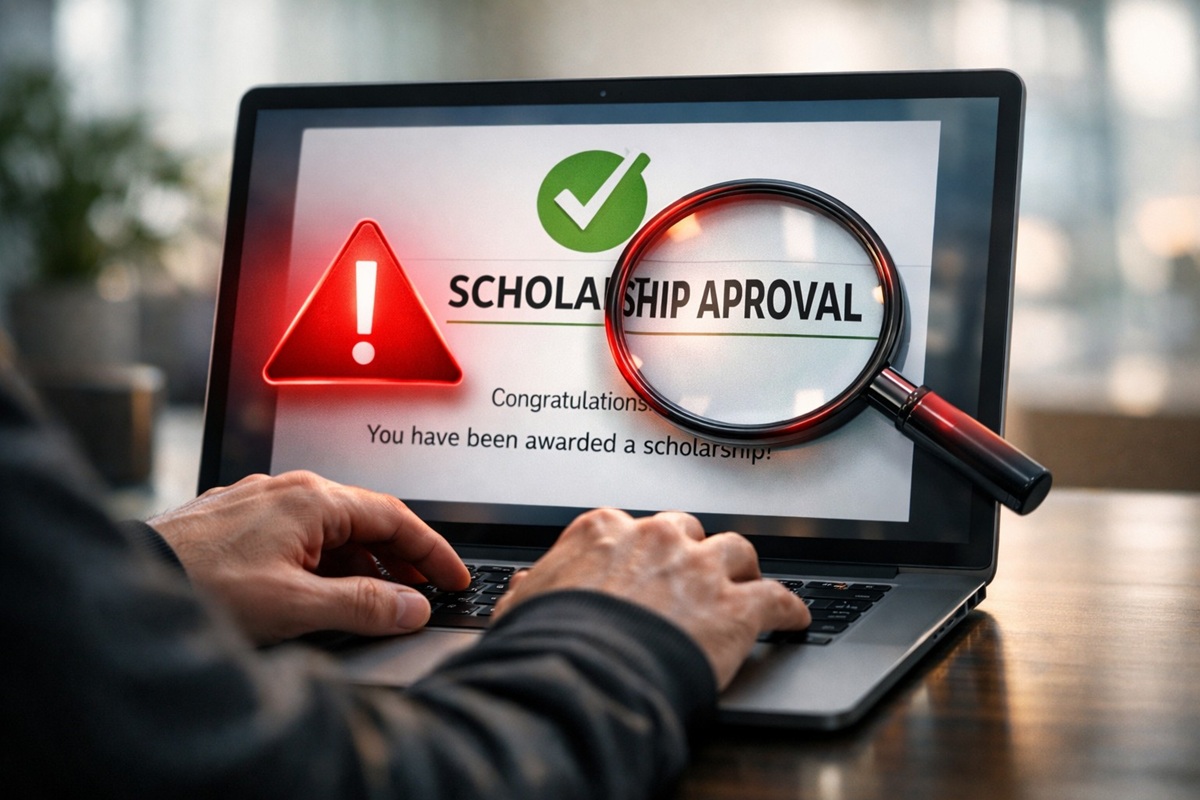
Scholarship scams exploit students’ financial stress, limited knowledge of the aid system, and the enormous demand for “free money for college.” Many schemes exist only to collect fees or harvest personal data, not to award real aid. With basic patterns, red flags, and verification habits, students and families can dramatically reduce their risk of losing money or exposing sensitive information.
Why Scholarship Scams Are So Common
The cost of college in the United States has risen faster than inflation for decades, making outside scholarships an attractive way to reduce borrowing. At the same time, the number of legitimate private scholarships is limited compared with the number of students searching for them, creating intense competition and a sense of scarcity. Scammers step into this gap, promising easy access to funds if students pay a fee, share personal data, or trust a “guaranteed” service.
Most students and parents only go through the scholarship search process once or twice, so they lack experience distinguishing real offers from scams. This information asymmetry gives scammers an advantage, especially when they use official-looking logos, government-sounding names, or polished websites. Common outreach channels—email, text, social media, and generic websites—are also the same channels where fraud losses in general now reach billions of dollars annually, so scholarship scams blend into a broader online fraud environment.
Scammers specifically target:
- Urgency: “Act now” deadlines and limited-time offers push students to decide before thinking or checking.
- Inexperience: First-generation and younger students may not know that reputable aid sources never charge application fees.
- Financial pressure: Families under stress are more likely to accept “too good to be true” offers that promise guaranteed money or special access to hidden funds.
Common Types of Scholarship Scams
Pay-to-Apply and “Processing Fee” Scams
In pay-to-apply scams, students are asked to pay an application fee, processing fee, or “redemption” fee to apply for or claim a scholarship. Sometimes the fee is small (e.g $10-20) to make it feel reasonable, while other times it is a substantial upfront charge for a “search service.”
The reality is that legitimate scholarships do not require students to pay to search, apply, or receive funds. Even when a company claims the fee is refundable, the Federal Trade Commission (FTC) has documented that such guarantees are typically meaningless and very hard to claim. Many families end up with nothing more than a low-quality list of outdated or unsuitable awards or nothing at all.
“Guaranteed Scholarship” or “You’ve Been Selected” Offers
Another common scam promises a guaranteed scholarship or announces that a student has been “selected” or is a “finalist” for an award they never applied for. Such offers may come by email, phone, letter, or social media direct messages and often insist that the student must pay a fee or share financial information to secure the award.
Legitimate scholarships are competitive and never guarantee funding before an application is reviewed. The FTC and college financial-aid offices warn that phrases like “the scholarship is guaranteed or your money back” or “you are a finalist in a contest you never entered” are classic signs of a scam. The goal is usually either to collect an upfront payment or to gather enough information to debit a bank account or engage in identity theft.
Fake Scholarship Search Services and “Exclusive Lists”
Fraudulent scholarship search services advertise that they will find scholarships for a fee, sometimes promising access to “billions in unclaimed aid” or “exclusive lists” not available anywhere else. In reality, these firms often provide only generic lists that are outdated, incomplete, or compiled from publicly available sources students could have accessed for free.
The FTC’s long-running enforcement efforts against bogus search services have shown that many companies collect significant upfront fees while delivering little or no value. Students can instead use free search tools from reputable organizations such as school financial-aid offices, college-planning nonprofits, or established matching platforms to find legitimate opportunities without paying.
Data Harvesting and Phishing Schemes
Some scholarship offers are primarily designed to harvest personal information rather than money. Application forms may ask for full Social Security numbers, bank account or credit card details, or credentials for federal aid systems like an FSA ID, even at very early stages. Scammers can then use this information for identity theft, unauthorized withdrawals, or to sell data to third-party marketers.
Phishing schemes frequently impersonate legitimate institutions, including government agencies or well-known colleges, using copied logos and lookalike website addresses. Federal Student Aid specifically warns that students should only log in to official sites and never share FSA ID credentials through links in unsolicited emails or texts. Requests to “verify eligibility” by entering banking or federal-aid login information on an unfamiliar site are a strong signal of fraud.
Impersonation of Colleges or Government Agencies
Impersonation scams send messages that appear to come from the U.S. Department of Education, the IRS, or “national foundations,” claiming that students qualify for special government grants if they pay a processing fee or confirm personal details. Some operations deliberately include terms like “federal,” “national,” or “foundation” in their names to sound official and trustworthy. Others spoof college domains or use nearly identical web addresses to mislead applicants.
Government agencies do not randomly contact individuals with unsolicited grants or scholarships and do not charge fees to access federal aid programs such as Pell Grants or federal loans. Official guidance emphasizes that free federal aid should be accessed only through legitimate government or institutional websites and that requests for payment or sensitive information from unknown third parties should be treated as scams.
Red Flags Students Should Watch For
Core Warning-Sign Checklist
A practical checklist helps students quickly evaluate offers before engaging:
- Requests for payment at any stage: Any fee to search for scholarships, apply, or receive funds is a strong red flag.
- Requests for highly sensitive personal information: Demands for Social Security numbers, bank details, or federal student aid login credentials, especially early in the process, should be treated with extreme caution.
- “Guaranteed” money or unsolicited winner notices: Promises of guaranteed scholarships or finalist notifications for contests you never entered are classic scam signals.
- Poor grammar, spelling, or unprofessional design: Scam emails and websites often contain obvious errors or sloppy formatting, suggesting a lack of legitimacy.
- Urgent pressure tactics: Messages that insist you must act immediately push you to skip critical verification steps.
- Vague or unverifiable organizations: If you cannot clearly identify who is funding the scholarship or how winners are chosen, the opportunity may not be real.
- No official website or weak contact information: A lack of transparency about the organization’s physical address or contact details is another red flag.
Using this checklist before filling out a form or clicking a link can help students quickly sort legitimate opportunities from suspicious ones.
How to Verify a Scholarship Is Legitimate
Step 1: Locate and Inspect the Official Website
Begin by finding the scholarship’s official website, ideally through a known and trusted source such as your school’s financial-aid office, a recognized nonprofit, or an established scholarship database. Check that the web address matches the organization’s known domain and is not a confusing imitation (for example, extra words, alternate spellings, or unusual domain endings).
On the site, look for clear information about who sponsors the scholarship, eligibility criteria, the application process, and contact details. Legitimate programs typically explain what population they serve (for instance, students in certain majors, regions, or backgrounds) and outline timelines and selection criteria in specific terms.
Step 2: Verify the Organization’s Existence
Search for the scholarship provider’s name separately in a search engine—do not rely solely on a link sent to you. See whether the organization appears in credible places such as a university website, a known nonprofit’s partner list, or a charity registry. For local scholarships, your high school counseling office or local community organizations can often confirm whether a sponsor is real.
Check for a physical address, working phone number, and official email connected to the organization’s domain. Be skeptical of arrangements where all communication happens through anonymous web forms or free email services without any verifiable institutional presence.
Step 3: Look for Past Winners and Clear Criteria
Real scholarship programs usually highlight past winners, selection stories, or at least statistics on how many students have received awards. While newer scholarships may not have a long track record, the absence of any concrete examples combined with vague language should prompt further scrutiny.
The eligibility and selection criteria should be specific enough that not everyone qualifies—for example, requiring a minimum GPA or particular field of study. Offers that claim “any student can apply” without meaningful criteria, coupled with fees or aggressive marketing, are more likely to be schemes focused on collecting payments or data.
Step 4: Cross-Check with Trusted Sources
Before applying, especially if something feels off, check with your school counselor, college financial-aid office, or a reputable college-planning organization. Counselors often maintain lists of vetted scholarships and may already know which offers circulating in your region are legitimate or problematic.
You can also look for the scholarship on well-known free platforms like Fastweb, College Board’s BigFuture, or similar databases that vet listings for scams. While these sites are not perfect and may list lower-quality marketing-driven “scholarships,” their teams generally review listings and remove obvious frauds.
Real-World Scam Scenarios
Scenario 1: The “Processing Fee” Trap
A high school senior receives an email congratulating them on being selected for a “National Scholars Award” worth several thousand dollars. To claim the award, the student is told to pay a 49-dollar processing fee within 48 hours via a link in the email. The message includes patriotic imagery and phrases like “federal” and “foundation” in the organization’s name, but the student has no recollection of applying.
What went wrong:
- The student believed a message announcing an award for which they never applied and accepted the idea that a scholarship could be “held” with a fee.
- They did not independently search for the organization’s name or verify its legitimacy, missing that there was no credible web presence and that the address was a mailbox rental.
What should have been noticed:
- “You’ve been selected” for a scholarship you never applied for, combined with a demand for a processing fee, is a standard scam script.
- A quick online search and a check with a school counselor likely would have revealed warnings or the absence of the organization from any trusted lists.
Scenario 2: The “Guaranteed Award” Search Service
A family attends a local college fair and is approached by representatives of a scholarship search company that guarantees students will receive at least 2,000 dollars in scholarships or their money back. The fee is nearly 200 dollars for access to the company’s “exclusive database” and one-on-one guidance. The family signs a contract on the spot.
What went wrong:
- They accepted the idea that scholarship outcomes could be guaranteed, despite scholarships being competitive by nature.
- They did not read the fine print of the “money-back guarantee,” which included conditions almost impossible to satisfy, such as applying to every scholarship on long lists with proof of each submission.
What should have been noticed:
- FTC guidance warns consumers to be wary of scholarship services that guarantee money or claim unique access to information.
- Free search tools and school-based resources provide similar or better information without large upfront fees.
Scenario 3: The Data-Harvesting Platform
A student signs up for an online “easy scholarship” platform that promises monthly random drawings and sweepstakes-type awards. The site is free to join but requires extensive personal data—full contact information, academic interests, and consent to receive marketing messages from “partners.” The student rarely applies for actual scholarships but begins receiving large volumes of promotional emails and calls about unrelated products.
What went wrong:
- The student assumed that any site using the term “scholarship” had their interests in mind and did not consider that the primary business model might be advertising and lead generation rather than awarding meaningful aid.
- They provided broad consent to share their data with third parties, resulting in ongoing marketing and potential privacy concerns.
What should have been noticed:
- The small size of the awards and sweepstakes-like structure are signals that the platform’s main goal is data collection.
- A careful reading of privacy policies and terms of service can reveal how data will be used and whether the tradeoff is worthwhile.
The Gray Area: Not Scams, But Still Problematic
Data-Driven but Legitimate Platforms
Some well-known scholarship search platforms, such as Fastweb and similar services, are widely regarded as legitimate and free to use, with teams that vet scholarships and remove suspected scams. These sites maintain large databases of opportunities and can be helpful starting points for students, as long as they are used thoughtfully.
However, their business models often rely on advertising, lead generation, and partnerships, meaning that users may receive frequent marketing emails and see sponsored listings alongside traditional scholarships. Reviews and expert commentary note that students can feel overwhelmed by email volume, duplicated listings, or “easy” sweepstakes-style awards that exist mainly to collect contact information.
How to Use These Platforms Wisely
Because these platforms are not scams in the strict sense, they can still be part of a balanced scholarship search strategy when used with caution. Students can create dedicated email addresses for scholarship-related sign-ups to prevent cluttering their main inboxes and reduce distraction. They should focus on more substantial awards with clear criteria rather than quick-entry sweepstakes that primarily benefit marketers.
It is also helpful to supplement large national databases with local or institutional scholarships identified by school counselors, community organizations, employers, and professional associations. Local awards often have fewer applicants and clearer connections to the student’s community, which can improve the chances of success without exposing them to excessive marketing.
Why Students Fall for Scholarship Scams
Financial Stress and Hope for “Free Money”
The high cost of tuition, books, and living expenses leads many students and families to feel desperate for any form of relief. In this context, offers that promise easy or guaranteed money are emotionally appealing, especially to those who worry they will not qualify for need-based aid. Scammers exploit this hope, framing their services as a lifeline rather than a risk.
Lack of Experience and Information
First-time college applicants, including many high school seniors and first-generation students, may not understand how legitimate scholarships and federal aid programs operate. They may not know that filing the FAFSA is always free, that reputable scholarships do not charge application fees, or that government agencies do not contact individuals directly with unsolicited grant offers. This knowledge gap makes it easier for scammers to present themselves as experts or necessary intermediaries.
Trust in Official-Looking Platforms
Professional design, convincing logos, and polished marketing copy can cause students to trust websites or emails that appear official, especially if they resemble college or government branding. Social proof—such as testimonials, fabricated badges, or claims of affiliation—can further reduce suspicion, even when there is no verifiable connection to the institutions mentioned.
In a crowded online environment, students also tend to assume that platforms they see frequently in search results or social media must be vetted or endorsed, even though advertising placement and search rankings are not guarantees of legitimacy.
Best Practices to Stay Safe
Core Safety Principles
Several straightforward practices can significantly reduce the risk of falling victim to scholarship scams:
- Never pay for scholarships or basic financial-aid help: Applying for federal aid through FAFSA and for legitimate scholarships should always be free. Be wary of any unsolicited offers that require payment to “release” funds.
- Limit the personal data you share: Provide only the information clearly needed for an application and be very cautious with Social Security numbers, bank details, or login credentials.
- Use a dedicated email for scholarship and college-related sign-ups: This helps control marketing messages and makes it easier to monitor important communications without overwhelming a primary inbox.
- Prioritize trusted sources: Start with your school’s financial-aid office, counselors, and local community organizations, then supplement with reputable national databases.
- Slow down when something feels urgent or “too easy”: Take extra time to verify any offer that promises guaranteed money or imposes immediate deadlines.
Practical Search Strategy
A safe and effective scholarship search strategy involves organizing your efforts to maximize results while minimizing risk.
- Start local: Meet with a school counselor early to learn about local and school-specific opportunities, which often have less competition.
- Use vetted databases: Rely on free, established matching platforms like Fastweb while filtering out sweepstakes-style offers.
- Track your progress: Track applications in a spreadsheet to stay organized, manage deadlines, and avoid duplicate submissions.
- Review privacy settings: Periodically review your account settings and email subscriptions on scholarship platforms to minimize unnecessary data sharing.
What to Do If You Encounter or Fall for a Scam
If You Spot a Suspicious Offer
If a scholarship offer raises red flags, stop engaging immediately—do not click further links, sign forms, or share additional information. Take screenshots or save the message, including any addresses or phone numbers, in case you need to report it.
You can report suspected scholarship or financial-aid scams to the FTC at ReportFraud.ftc.gov, which helps authorities track patterns and pursue enforcement. It is also wise to inform your school counselor or financial-aid office so they can warn other students and confirm that their own systems have not been compromised. For scams involving federal aid, you can also submit feedback or report suspicious activity directly to the Department of Education.
If You Shared Money or Sensitive Data
If you paid a fee to a fraudulent service, contact your bank or card issuer immediately to dispute the charge. Under federal law, you typically have 60 days from the statement date to initiate a formal challenge. When bank account or credit card numbers may have been exposed, you may need to monitor statements closely or request new account numbers.
If you shared a Social Security number or believe you are at risk of identity theft, visit IdentityTheft.gov to create a recovery plan. You should also place a fraud alert on your credit file with the three major bureaus (Equifax, Experian, and TransUnion). Federal guidance also recommends changing passwords for any potentially compromised accounts and enabling multi-factor authentication to prevent unauthorized access.
Be Skeptical, Not Fearful
Scholarships and legitimate financial aid remain important tools for making education more affordable, and many students successfully secure meaningful awards each year. At the same time, a parallel ecosystem of scams seeks to profit from students’ urgency, inexperience, and financial pressure through fees and data harvesting. Recent data from the Federal Trade Commission (FTC) shows that fraud losses continue to rise, making it more important than ever to recognize red flags before sharing any information.
The safest approach is not to avoid all scholarship opportunities, but to apply informed skepticism and simple verification habits to every offer. By remembering that real aid does not require payment, being cautious with personal data, and double-checking the legitimacy of organizations through official government resources, students can protect their money and identity while still pursuing genuine scholarships.