


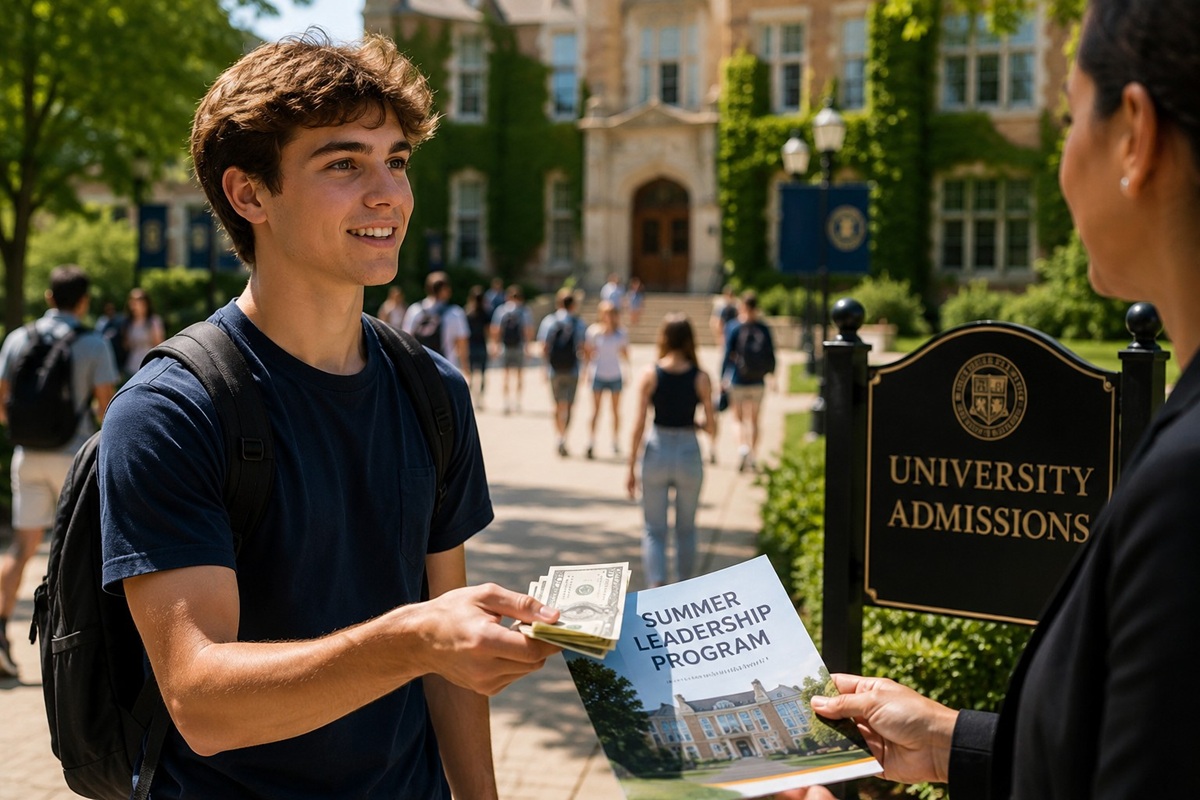
The high school summer vacation, historically viewed as a period of rest and physical recuperation, has been systematically transformed into a critical phase of academic portfolio building. Driven by the rising competitiveness of highly selective college admissions, families worldwide seek structured avenues to demonstrate intellectual vitality, secure institutional brand alignment, and optimize their academic profiles. Among the most prominent responses to this demand is the pre-college summer program, a model typically hosted on elite university campuses that promises secondary school students a taste of collegiate academic and residential life, such as Harvard’s Pre-College Program.
This has given rise to a highly lucrative industry of “pay-to-play” summer programs. These are defined as summer courses or seminars hosted by prestigious universities that require substantial out-of-pocket tuition payments but feature open-enrollment or minimally selective admissions policies. While marketing materials for these programs frequently align themselves with the selective reputation of their host institutions, a structural misalignment exists between the consumer perception of these programs and the empirical reality of how undergraduate admissions offices evaluate them—as reporting from the Brown Daily Herald underscores that pre-college attendance does not help students gain undergraduate admission.
This analysis provides an evidence-based evaluation of the relationship between expensive pre-college programs and undergraduate college admissions. By examining official university policies, institutional financial reports, Common Data Sets, and college counseling research, this report details the mechanics, economic incentives, and strategic tradeoffs of the summer pre-college landscape.
Here is the text with the end-of-sentence citations replaced by smoothly integrated in-line hyperlinks wrapping the relevant terms:
The Landscape of Pre-College Summer Programs: A Comprehensive Comparison Database
To navigate the complex ecosystem of summer options, families must understand that summer programs vary widely in cost, credit-bearing status, selectivity, and administrative structure. The database below synthesizes dozens of prominent university programs across these core operational parameters, utilizing official institutional data.
Official University Policies: The Separation Between Summer Programs and Undergrad Admissions
To understand the core mechanics of college admissions summer activities, families must examine the administrative division between university summer schools and undergraduate admissions offices. According to investigative reporting by the Brown Daily Herald, pre-college summer programs at the vast majority of institutions are completely isolated from the evaluation processes that govern first-year degree admissions.
This administrative separation is driven by institutional design and clear bureaucratic boundaries. While undergraduate admissions offices are tasked with shaping a matriculated first-year cohort under highly stringent institutional enrollment mandates, pre-college programs are managed as separate business units, often housed under divisions of continuing education, professional studies, or auxiliary summer sessions. Consequently, undergraduate admissions officers are generally uninvolved in reviewing pre-college applications, do not teach the courses, and do not track whether a first-year applicant previously attended their institution’s summer camp.
The table below catalogs official disclaimers from top-tier research universities, confirming this structural divide.
| University | Managing Administrative Unit | Official Policy Statement regarding Undergraduate Admissions Impact |
|---|---|---|
| Brown University | School of Professional Studies | “Brown’s admissions office does not receive the names of pre-college participants, does not track these students during the application process and has no information on their admissions outcomes.” — Brian Clark, University Spokesperson. |
| Columbia University | School of Professional Studies | “Columbia University’s Pre-College Programs are distinct from Columbia University’s undergraduate school, Columbia College. Before applying to one of the pre-college programs, students should understand that their participation will have no greater influence than any other similar extracurricular activity.” |
| Harvard University | Harvard Summer School / Division of Continuing Education | “Attending Harvard Summer School and performing well will strengthen your application to any college or university… CPP alone does not guarantee your acceptance to Harvard.” Note: The program provides general college preparation but carries no formal admissions weight. |
| Stanford University | Stanford Pre-Collegiate Studies | “Stanford admissions officers do not weight SPCSI participation as meaningful signal, and the credential’s broad adoption among affluent applicants has commoditized its admissions value.” |
| Northwestern University | School of Professional Studies | “Participation in the CPP is one of the many pieces of your application profile; it alone does not guarantee your acceptance to Northwestern University.” |
| University of Southern California | USC Bovard College / Pre-College Online | “While enrolling in one of these courses can indicate your interest in the university and passion for a specific academic area, it does not guarantee admission or a special preference in the admissions process.” |
This institutional reality dismantles one of the most pervasive college admissions myths: the belief that spending a summer on a prestigious campus establishes a proprietary pathway to matriculation at that specific university. Admissions offices evaluate a high school student’s summer portfolio based on its academic rigor, intellectual vitality, and demonstrated depth, rather than the brand of the university that issued the summer invoice, a sentiment echoed by expert counseling panels on CollegeVine.
The Golden Exceptions: Verified Academic and Structural Admissions Pathways
While the general administrative rule dictates strict separation, specific universities have engineered summer programs that provide direct, structural advantages in the undergraduate admissions process, as tracked by Aralia Education. These opportunities represent the true unwritten rules of summer planning, moving beyond general academic enrichment to offer concrete procedural benefits detailed by college consultants at Ivy Coach.
The table below organizes these unique programs, documenting their mechanisms and verified admissions connections.
| University | Program Name | Structural Admissions Mechanism | Verified Strategic Advantage / Outcome |
|---|---|---|---|
| University of Chicago | UChicago Summer Session (All Programs) | Summer Student Early Notification (SSEN / ED0): Exclusive binding early decision application round explained in the UChicago Summer Session policy. | Eligible students apply between Sept 1 and Oct 15. They receive a binding decision by Nov 1. If rejected or deferred, the student can apply to another school’s traditional ED I round by the Nov 1 deadline. |
| Carnegie Mellon University | Pre-College Summer Session | Academic Grade Forgiveness Policy: Registrar safeguards the student’s permanent record from low grades. | High school students take credit-bearing undergraduate courses. To encourage academic risk-taking, the CMU Registrar only retains grades of “A” or “B” on the permanent transcript; grades of “C”, “D”, or “R” (fail) are completely expunged for students in good standing. |
| University of Pennsylvania | Summer Pre-College Program (Residential/Online) | Direct Academic Transcript Merging: Internal credit consolidation upon matriculation, as outlined in Penn’s residential summer overview. | Penn does not accept pre-college credits taken at other universities during high school, according to the official Penn Admissions pre-college policy. However, credits earned by taking regular undergraduate Penn courses during the summer merge directly onto the student’s undergraduate record if they are eventually admitted, bypassing transfer restrictions. |
| University of Michigan | Stamps Portfolio Prep | Integrated Faculty Portfolio Reviews: Direct evaluation by the Stamps School’s admissions committee. | Rather than applying to a generalized enrichment program, students build their creative portfolio directly under the supervision of U-M Stamps faculty and receive formal portfolio evaluations from the admissions staff, directly informing their eventual undergraduate application. |
These structural pathways confirm that not all paid summer programs are identical, according to guides compiled by Pioneer Academics. While standard enrichment camps offer soft educational benefits, programs that offer transcripted grades with safety mechanisms or proprietary early admissions application windows provide measurable strategic leverage.
Highly Selective Merit-Based Summer Programs: The Elite Signals
Most college access guides state that “no summer program helps with college admissions.” While this holds true for open-enrollment, tuition-driven programs, it is fundamentally incorrect when applied to highly selective, fully funded merit programs, as noted by admissions experts at Oriel Admissions.
Admissions officers at the nation’s most competitive universities recognize a tier of elite summer programs that serve as powerful independent signals of talent. These programs do not carry weight because of their host campus, but because their extreme selectivity serves as an external validation of a student’s academic capability. Admittance to a summer program with a single-digit acceptance rate tells admissions readers that the applicant has already survived a rigorous vetting process comparable to, or more competitive than, undergraduate admissions at the Ivy League.
The table below catalogs the highly selective, academically prestigious summer programs that admissions offices recognize as gold-standard credentials.
| Sponsoring Organization / Host | Program Name | Acceptance Rate | Cost to Family | Funding Sources & Model | Admissions Reputation & Academic Focus |
|---|---|---|---|---|---|
| MIT / Center for Excellence in Education | Research Science Institute (RSI) | ~2.5% – 3% | $0 (Fully Funded) | Supported by MIT resources, corporate sponsors, and the CEE endowment. | Gold Standard STEM Signal: 6 weeks of advanced theory followed by mentored, individual laboratory research culminating in a publishable scientific paper and symposium presentation. |
| SSP International / Multi-Campus | Summer Science Program (SSP) | ~4% – 5% | Slidingscale; $0 for family incomes <$75K up to ~$11,800 max. | Need-blind admissions model supported by alumni donations and institutional partners. | Premier Collaborative STEM Signal: 39 days of collaborative research in astrophysics, genomics, or biochemistry; highly respected for verifying hands-on research capacity. |
| Texas Tech University | Anson L. Clark Scholars Program | ~2% (Exactly 12 students per year) | $0 (Fully Funded + $750 stipend) | Funded through the Clark Foundation endowment, which ranks it among the best summer programs for high school students. | Elite Research Signal: 7 weeks of intensive, 1-on-1 research with TTU faculty mentors across STEM and humanities; provides direct scientific validation. |
| Carnegie Mellon University | Summer Academy for Math and Science (SAMS) | ~5% – 10% | $0 (Fully Funded) | Funded by CMU’s Center for Student Diversity to build socioeconomically diverse pipelines. | Top Tier STEM Pipeline Signal: 6 weeks of rigorous, credit-bearing math and science coursework coupled with collaborative hands-on projects. |
| Princeton University | Princeton Summer Journalism Program (PSJP) | ~3% – 5% (Exactly 35–40 students) | $0 (Fully Funded; travel/meals covered) | Housed in the Emma Bloomberg Center for Access and Opportunity. | Elite Humanities Signal: Hybrid intensive culminating in a 10-day residential program and publication of The Princeton Summer Journal; features year-long 1-on-1 college counseling. |
| Stanford University | Stanford Institutes of Medicine Research (SIMR) | <5% | $0 (Fully Funded + $500–$2,500 stipend) | Supported by the Stanford School of Medicine and philanthropic grants. | Elite Biomedical Signal: 8 weeks of hands-on laboratory research mentored directly by Stanford faculty and researchers; highly localized Commuter-first. |
| UC Santa Barbara | Research Mentorship Program (RMP) | ~4% – 6% | $5,675 (commuter) to $13,274 (residential); need-based aid | Supported by UCSB Summer Sessions; need-based scholarships exist. | R1 University Research Signal: 6 weeks inside active laboratories working directly on interdisciplinary research, culminating in a formal research symposium. |
Attending these programs serves as a powerful signal because it is earned, not purchased. Conversely, listing an open-enrollment, expensive summer camp on an application signals financial capacity rather than academic distinction, a sentiment echoed in strategic analyses of Stanford’s summer program pricing models.
Deeper Sociological and Economic Dynamics: Critical Conceptual Frameworks
To move beyond the surface question of whether a program is “worth it,” families must evaluate pre-college summer programs through several core concepts in sociology and educational economics. This perspective exposes the structural incentives and societal divisions driving the summer pre-college market.
1. The Business Model: Institutional Branding as a Revenue Engine
In the modern higher education economy, public and private universities face structural financial constraints, including historical cuts in state funding, caps on academic-year tuition, and volatility in first-year enrollment yields. In response, institutions must diversify their operations by generating alternative, non-tuition revenues.
Underutilized campus infrastructure during the summer months represents an operational inefficiency. While academic buildings, classrooms, and residence halls sit partially vacant, fixed administrative and maintenance costs remain constant. Pre-college summer programs resolve this issue by converting these underutilized capital assets into highly profitable auxiliary operations.
These programs operate on a high-margin, short-term model, charging premium tuition rates that far exceed the per-week instructional cost of standard undergraduate tuition. By utilizing graduate student teaching assistants and temporary instructors, universities maintain low labor costs while capitalizing on their prestigious brand equity to charge premium rates to affluent families.
This dynamic mirrors the business models of executive education or professional certificate programs. In these spaces, a university’s brand is leveraged to generate high-margin auxiliary revenues from non-traditional, non-degree-seeking student populations. This structural revenue stream supports core academic budgets and funds financial aid initiatives for the primary undergraduate population, making pre-college programs a rational institutional strategy.
2. Prestige vs. Admissions Value: The Illusion of Affiliation
Families often fall victim to the “illusion of affiliation,” conflating access to physical spaces with actual institutional membership. Pre-college marketing materials are heavily saturated with highly polished campus imagery—such as historical brick dormitories, manicured quads, and gothic libraries. This visual branding implies that a student’s physical presence on campus for two weeks reflects an active relationship with the host university.
In reality, the barrier to entry for these spaces is low. Paying $6,100 to live in a dormitory and attend a non-graded, non-credit seminar does not establish an academic connection with the university’s undergraduate division. The admissions standard applied to summer programs is designed to verify basic behavioral maturity and English language proficiency, whereas undergraduate admissions evaluates a student’s long-term academic excellence and institutional fit.
The resulting certificate of participation is a commercial product of the continuing education division, carrying no formal weight when reviewed by the undergraduate admissions committee.
3. Correlation vs. Causation: The Selection Bias Trap
One of the most pervasive misconceptions in the college planning space is the observation that students who attend expensive pre-college summer programs frequently matriculate at highly selective universities. This correlation is often mistaken for a causal relationship. In reality, this pattern is a classic demonstration of selection bias and survivorship bias.
Pre-Existing Academic Rigor + Socioeconomic Resources => Pre-College Enrollment + Elite College Admission
Students who enroll in $6,000-to-$12,000 summer programs are a highly self-selected cohort. They typically come from high-income families, attend well-resourced private or suburban public schools, have access to academic advising, and maintain strong baseline GPAs.
These students possess academic and socioeconomic profiles that make them highly competitive candidates for selective admissions from the outset. The expensive pre-college program is a reflection of their pre-existing academic and financial advantages, not the cause of their eventual college acceptance.
4. Summer Programs as Signals: Wealth vs. Vitality
In educational sociology, signaling theory examines how an applicant communicates unobservable traits—such as intellectual ability, drive, and resourcefulness—to an admissions committee. Admissions officers are trained to evaluate student portfolios contextually, distinguishing between signals of wealth and signals of genuine academic talent.
An expensive, open-enrollment pre-college program serves as a primary signal of financial capacity rather than academic capability. Because the program is accessible to any family with the means to pay, it fails to demonstrate unique academic talent.
In contrast, highly selective free programs (such as RSI or SSP) signal exceptional ability and intellectual vitality. Admissions officers prioritize these selective opportunities because they represent merit-based validation that a student has succeeded under demanding, peer-reviewed standards.
5. Opportunity Cost: What Students Give Up
The decision to allocate several weeks and thousands of dollars to a paid pre-college program carries a significant opportunity cost. Families must evaluate what alternative activities are forfeited during that time:
- Employment: Working a standard, low-wage hourly job (such as food service or retail) signals reliability, accountability, and maturity. Admissions offices often view sustained employment as a stronger indicator of personal responsibility than an expensive on-campus summer camp.
- Family Caregiving: Taking on household responsibilities, such as caring for younger siblings or supporting a family business, is evaluated with significant weight under a holistic review framework.
- Independent Projects: Launching a self-directed project, conducting local historical research, or building an original artistic portfolio demonstrates a level of initiative that pre-packaged, on-campus courses cannot replicate.
These alternative activities often provide more distinctive and compelling material for college essays and personal statements than a standard, predictable pre-college summer experience.
6. Equity Concerns and Contextual Admissions
The widespread growth of paid pre-college programs has widened the opportunity gap between wealthy applicants and those from low-income or first-generation backgrounds. To address this imbalance, selective universities have increasingly refined their holistic and contextual review processes.
Under contextual review, admissions officers do not evaluate applications against a universal standard of opportunity. Instead, they assess an applicant’s achievements relative to the resources, high school profile, and socioeconomic realities of their home environment.
If a student attends an under-resourced high school and has family caregiving responsibilities or a part-time job, admissions offices do not penalize them for lacking expensive summer credentials. Conversely, they view the student’s ability to maintain academic excellence while managing real-world responsibilities as a powerful indicator of future collegiate success.
Admissions Office Perspectives: What Colleges Actually Value
To align summer activities with the expectations of selective universities, families should look directly at institutional reporting and statements from admissions leadership.
The Common Data Set Evidence
Under Section C7 of the Common Data Set (CDS), universities are required to explicitly rank the factors they evaluate during first-year admissions. An analysis of the CDS from highly selective institutions, including Duke, Vanderbilt, Johns Hopkins, and Northwestern, reveals a consistent trend: “pre-college camp attendance” is not listed as an independent admissions factor.
Instead, these documents highlight that the factors classified as “Very Important” or “Important” are:
- Rigor of secondary school record (academic curriculum difficulty)
- Academic GPA
- Application essays
- Letters of recommendation
- Extracurricular activities
Paid summer programs are reviewed under the broad category of “extracurricular activities” or “academic enrichment.” Within this category, admissions offices prioritize depth, sustained commitment, and tangible impact over brand name or financial cost.
Official Guidance from Admissions Leaders
The National Association for College Admission Counseling (NACAC) and major university admissions blogs emphasize that summer activities should focus on genuine engagement rather than credential accumulation. Admissions offices seek applicants who display three core traits:
- Intellectual Curiosity: Pursuing an academic interest deeply and independently, whether through free online platforms, local library resources, or self-directed projects.
- Impact and Contribution: Demonstrating an active engagement with one’s immediate community, such as organizing a local initiative, tutoring peers, or volunteering with civic organizations.
- Authenticity: Selecting summer activities that genuinely reflect the student’s personal passions rather than what they believe “looks good” on a resume.
A student who pursues a local, low-cost activity with high personal investment and distinct results will consistently stand out more than an applicant who passively attends a premium pre-college program.
Marketing Language Analysis: Deconstructing University Rhetoric
Pre-college program brochures and websites utilize highly persuasive marketing copy designed to encourage families to enroll. The table below analyzes common pre-college marketing phrases and deconstructs their underlying operational reality.
| Common Marketing Phrase | Perceived Meaning to Families | Deconstructed Operational Fact |
|---|---|---|
| “Future Leaders” & “Scholars” | Attending this program indicates the student has been recognized as an elite academic leader. | These are generic marketing descriptors used to validate the customer and create a sense of prestige. They carry no academic or structural weight in undergraduate admissions. |
| “Elite” & “Exclusive” | The program is highly selective and limited to top-tier applicants. | The program is “exclusive” primarily based on the high cost of tuition, which serves as a financial barrier. The actual acceptance rates for these paid sessions are typically high. |
| “Immersive” & “Transformational” | The experience will fundamentally reshape the student’s academic standing and college prospects. | The academic coursework is condensed into a brief window (typically 1–3 weeks), providing introductory exposure rather than deep academic mastery. |
| “Build Your Portfolio” | The coursework will produce a unique, proprietary piece of work that guarantees admission. | While some programs (like art portfolio prep or game design) offer structured portfolio guidance, the value lies in the student’s final work, which is evaluated on its individual merit, not where it was created. |
This analysis confirms that pre-college marketing is designed to maximize program enrollment and revenue, and should be evaluated with critical consumer awareness.
Practical Evaluation Frameworks for Families
Before investing significant financial resources in a paid summer program, families should apply the following evaluation framework to make an informed, strategic decision.
The Five Questions to Ask Before Spending $5,000
- Who is the administrative organizer of this program? Is the program managed directly by the undergraduate admissions office, or is it operated as an auxiliary unit by a division of continuing education?
- Is enrollment selective, and does the program publish its admissions data? Does the program require verified transcripts, competitive essays, and recommendations, or does it utilize rolling admissions to fill classroom capacity?
- What is the structural admissions relationship? Does the university explicitly state that participation provides zero admissions advantage, or is there a documented structural pathway like UChicago’s SSEN round?
- What is the tangible output of this experience? Will the student produce a verified research paper, a curated art portfolio, or transcripted college credit, or will they simply receive a general certificate of attendance?
- Would the student still choose to attend if they could not list this program on their college application? If the answer is no, the investment is likely focused on a brand purchase rather than genuine academic interest.
Red Flags vs. Green Flags in Pre-College Programs
To help families distinguish between high-value educational programs and low-value revenue generators, this matrix organizes key program indicators.
| Red Flags (Proceed with Caution) | Green Flags (High Value) |
|---|---|
| Guaranteed Admissions Implications: The program implies that attendance directly improves a student’s undergraduate admission chances. | Transparent Admissions Data: The program publishes historical acceptance rates, average GPAs, and cohort demographics. |
| High Cost with Zero Financial Aid: The program charges premium tuition rates while offering minimal or no need-based scholarships. | Robust Need-Based Scholarships: The program covers full tuition, housing, and travel costs for low-income and underrepresented students. |
| Open Rolling Registration: The application process features minimal academic review, admitting any student who pays the enrollment deposit. | Tangible Academic and Creative Outputs: Students produce a portfolio piece, complete an original research project, or earn verified credits. |
| Heavy Emphasis on University Branding: Marketing materials focus primarily on host campus prestige rather than course-specific academic rigor. | Clear Admissions Disclaimers: The program clearly and directly explains its administrative separation from undergraduate admissions. |
High-Impact, Low-Cost Alternatives for Low-Income and First-Generation Students
For students with limited financial resources, attempting to match the expensive summer portfolios of wealthy peers is neither practical nor necessary. Admissions offices contextually evaluate opportunity, highly valuing students who demonstrate resourcefulness, maturity, and initiative within their local communities.
The table below outlines high-impact, zero-cost summer activities that build a strong college application portfolio.
| Alternative Activity Category | Key Focus & Academic Signal | Strategic Value in College Admissions | Implementation Guidance for Students |
|---|---|---|---|
| Standard Employment | Maturity & Accountability: Signals real-world responsibility, time management, and work ethic. | Highly respected by admissions readers; demonstrates resilience and the ability to manage real-world commitments. | Pursue sustained part-time work, such as food service, retail, or camp counseling; document contributions to family expenses. |
| Self-Directed Research | Intellectual Curiosity: Demonstrates the drive to explore an academic interest outside the classroom. | Signals a strong alignment with what colleges look for, showcasing initiative and the ability to engage in independent study. | Identify a research question; utilize free local library databases or open-source archives; compile a formal research paper. |
| Local Community Service | Civic Engagement & Impact: Shows a commitment to supporting and improving one’s immediate community. | Demonstrates leadership, empathy, and a strong sense of civic responsibility. | Partner with local non-profits, religious communities, or civic programs to lead a targeted community initiative. |
| Free Online Coursework | Academic Initiative: Showcases a self-motivated pursuit of advanced concepts. | Demonstrates intellectual drive and the ability to manage self-paced academic environments. | Enroll in free asynchronous courses, such as U-M’s Stamps Pre-College Anytime, or open-source platforms. |
| Family Caregiving Roles | Responsibility & Resilience: Reflects maturity and significant contributions to household stability. | Evaluated highly under contextual admissions review, explaining how a student’s time is balanced with family needs. | Detail significant family contributions, such as caring for younger siblings, managing household tasks, or supporting a family business. |
By focusing on these authentic, high-impact activities, students can build a distinctive and competitive college application portfolio while avoiding the high costs of pay-to-play pre-college programs.
A Roadmap for High-Impact Summer Decisions
Expensive, open-enrollment pre-college programs operate primarily as high-margin, revenue-generating initiatives for university continuing education divisions and as general enrichment opportunities for families. While these programs can offer valuable campus exposure and introductory academic exploration, they do not provide a direct advantage in undergraduate admissions at highly selective colleges.
To build a competitive application, students should prioritize highly selective merit-based programs, understand the direct admissions pathways of specific institutions, or engage in high-impact, self-directed local activities. Admissions offices contextually evaluate a student’s summer portfolio, valuing genuine intellectual curiosity, maturity, and community impact over premium brand purchases.
Here is a rewritten version of the conclusion that explicitly transforms it into a strategic, step-by-step roadmap for families to follow.
Navigating the summer landscape requires moving past university branding to focus on true admissions value and personal growth. Instead of viewing summer planning as a search for the most prestigious campus label, families can use this evidence-based framework to chart a high-impact strategy.
Determine the Program’s True Intent: Step 1: Check the Organizer. Identify who runs the program. Look at the website footer or “About” page: is it run by the undergraduate admissions office, or an auxiliary division of continuing education? If it is the latter, treat it as personal enrichment, not an admissions shortcut.
Audit the Selectivity and Admissions Data: Step 2: Assess the Merit Signal. Look for transparent data. Does the program publish a single-digit acceptance rate, require competitive teacher recommendations, and offer full merit funding? True “gold-standard” signals cost nothing but have incredibly high academic bars. If registration is rolling and open to anyone who pays, the admissions value drops significantly.
Identify Structural Anomalies: Step 3: Screen for Procedural Benefits. Check if the specific university has a documented, verified policy that rewards attendance. Look for exceptions like institutional grade-forgiveness policies or dedicated application review rounds (such as UChicago’s SSEN). If these explicit pathways do not exist, assume the program carries zero structural weight.
Map Out Local, High-Impact Alternatives: Step 4: Maximize Contextual Opportunity. If a program is a paid, open-enrollment model, weigh it against free local alternatives. Admissions offices evaluate students contextually based on their available resources. A summer spent working a retail job, managing family caregiving responsibilities, or leading a self-directed local research project often signals more maturity and resourcefulness than passively attending a premium pre-college camp.
The Ultimate Test: Before submitting a deposit for any premium pre-college experience, ask one final question: Would the student still choose to spend their time and energy on this program if they were completely forbidden from listing it on their college application? If the answer is no, skip the expense and focus on an authentic, local project that genuinely reflects their passions.