

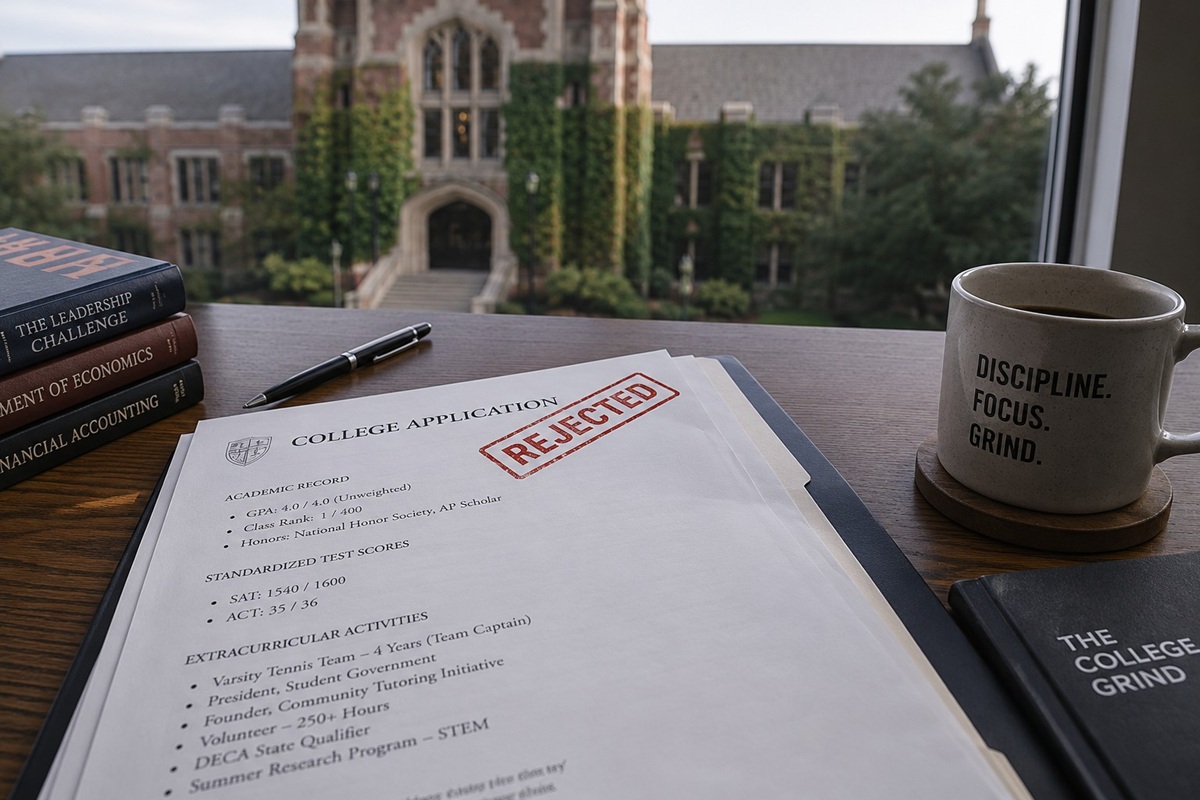
Each spring, a familiar and painful ritual unfolds in competitive high schools across the country. Two classmates with seemingly identical academic records receive vastly different decisions from the same highly selective university. One student, carrying a perfect 4.0 unweighted grade point average, a near-perfect 1570 SAT score, and a long list of extracurricular titles, is rejected or waitlisted. Meanwhile, a classmate with a slightly lower standardized test score or a less extensive list of leadership positions is offered admission.
This divergence frequently leads families to conclude that the college admissions process is either a meaningless lottery, fundamentally unfair, or entirely random. Families often compare classmates side-by-side, operating under the assumption that college admissions should function as a pure, objective meritocracy where the student with the “better numbers” is automatically rewarded with an acceptance letter.
The reality, however, is far more complex. Highly selective college admissions do not operate on a simple merit-ranking system. Instead, the admissions process is contextual, institutional, and comparative. Colleges are not ranking applicants from best to worst to admit the top slice of the pool; rather, they are assembling a diverse, balanced incoming class designed to meet specific institutional needs under extreme capacity constraints. In this environment, “qualified” does not mean “identical,” and a rejection letter is rarely an indictment of a student’s capability or worth. To understand why equally qualified students get different admissions results, one must examine the hidden mechanisms of enrollment management, academic specialization, and institutional priorities, which explain why top students get rejected from safety schools and selective universities alike.
Selective Colleges Reject Thousands of Qualified Students
To understand the modern admissions landscape, families must first grasp the sheer imbalance between supply and demand at the nation’s most selective institutions. Over the past decade, application volumes have surged to historic levels, driven in large part by the simplicity of the Common Application, the persistence of test-optional policies, and a growing global demand for elite higher education.
For the Class of 2030, the Common Application reported that more than 1.4 million distinct first-year applicants submitted over 9.4 million applications to returning member institutions, representing a 5% year-over-year increase in total application volume. On average, students applied to 6.59 colleges each, a steady increase from the 6.41 average recorded the prior year. For the Class of 2029, the Common Application saw 7.1 million submissions, demonstrating a clear multi-year upward trajectory according to Oriel Admissions’ tracking of top 25 school statistics.
This massive expansion of the applicant pool has occurred while the physical capacity of freshman classes has remained largely static, leading to unprecedented compression in acceptance rates.
| School | Projected Class of 2030 Acceptance Rate | Class of 2029 Acceptance Rate | Estimated Class of 2030 Application Volume |
|---|---|---|---|
| Harvard University | ~3.0% | 3.6% | ~56,000 |
| California Institute of Technology | ~3.0% | 2.7% | ~18,000 |
| Columbia University | 4.23% | 3.9% | 61,031 |
| Stanford University | ~4.0% | 3.7% | ~56,000 |
| Massachusetts Institute of Technology | 4.6% | 4.0% | 28,349 |
| Yale University | 4.2% | 4.6% | ~54,000 |
| Brown University | 5.35% | 5.2% | 47,937 |
| Duke University | 4.7% | 4.8% | ~54,000 |
| University of Pennsylvania | ~6.0% | 5.4% | ~68,000 |
| Vanderbilt University | ~6.0% | 5.1% | ~48,000 |
| Northeastern University | ~6.0% | 7.0% | ~96,000 |
| Northwestern University | ~7.0% | 5.7% | ~55,000 |
| Cornell University | ~8.0% | 7.9% | ~75,000 |
| Johns Hopkins University | ~8.0% | 6.0% | ~38,000 |
| New York University | ~8.0% | 8.0% | ~125,000 |
Data compiled across sources including Expert Admissions’ Class of 2030 analysis, EduAvenues’ Class of 2029 reports, Forbes’ admissions coverage.
At highly selective colleges, academic excellence is no longer a differentiator; it is merely a prerequisite for consideration. At an institution like Harvard, where the mid-50% SAT range is 1500–1580 and the ACT range is 34–36, the vast majority of the 57,000+ applicants possess the academic credentials to succeed on campus. Admissions offices routinely reject thousands of students with perfect 4.0 GPAs and maximum standardized test scores.
This reality underscores the vital difference between being “qualified” and being “admittable.” A qualified student has demonstrated, through grades, curriculum rigor, and test scores, that they can handle the academic workload of an elite institution, prompting selective programs to scrutinize academic rigor closely. An admittable student, however, possesses those academic baselines plus specific qualities, talents, or institutional alignments that distinguish them from thousands of academically identical peers. When explaining why students with perfect grades get rejected, it becomes clear that academic metrics are merely a filter to clear the first stage of review, not a guarantee of admission. Understanding why qualified students get rejected from college requires stepping away from personal transcript evaluations and examining the broader dynamics of yield protection and enrollment management.
Why Admissions Is About Building a Class, Not Ranking Students
The central misunderstanding for many families is the belief that college admissions is a competition to find the “best” individual students. If admissions offices were simply ranking applicants by a single academic score, the process would be transparent, but it would also fail to serve the educational mission of the university. Elite colleges do not want a class of academically identical students who all share the same interests, backgrounds, and career goals.
Instead, how selective college admissions work is centered on class construction, often described through the “orchestra analogy.” A conductor charged with building a world-class symphony orchestra cannot simply recruit the 100 finest musicians if all of them happen to play the violin. An orchestra requires a balanced distribution of instruments: flutists, cellists, percussionists, and oboists. If the conductor admits a brilliant violinist over an equally brilliant oboist simply because the violinist scored slightly higher on a technical music assessment, the orchestra’s performance will suffer due to a lack of structural balance, which is why playing an instrument can affect college admissions in highly specific ways.
In the same way, an admissions committee must build a balanced campus community. This involves ensuring representation across several key dimensions:
- Geographic Balance: Universities seek representation from all 50 states and dozens of countries to foster global perspectives on campus, a trend reflected across the historical statistics of top 25 schools.
- Academic Diversity: A college must populate its entire range of academic departments, ensuring that there are classics majors alongside computer science majors.
- Campus Community Composition: Admissions offices must consider athletic recruits, performing artists, student leaders, and community organizers to maintain a vibrant residential life, heavily weighing how admissions officers rate your application as a whole.
Because applicants are not competing in one giant, universal pool, comparisons between two students from the same high school are often deeply flawed. A student intending to major in French literature is not competing against a classmate applying to the engineering department. They are being evaluated within different comparative pools, each with its own supply-and-demand dynamics, capacity limits, and institutional priorities, creating a stark contrast in acceptance rates by major like computer science versus the humanities. This structure explains why top students get rejected while seemingly less qualified peers gain entry, as their applications are filtered through entirely different institutional lenses.
Intended Major Quietly Changes the Odds
One of the most significant and least understood factors in modern admissions is the role of the intended major. While some elite universities, such as MIT and Stanford, admit students to the university as a whole and allow them to choose a major later, many prominent institutions admit students directly by division, school, or specific department. At these “admit-by-major” institutions, the overall published acceptance rate of the university is highly misleading, highlighting a massive discrepancy in college acceptance rates by major.
For families targeting highly competitive pre-professional programs—such as Computer Science, Engineering, Business, or Nursing—the actual acceptance rate can be a fraction of the university’s publicized rate.
| Institution | Highly Competitive Major / School | Major-Specific Admit Rate | Less Competitive Major / School | General / Alternate Admit Rate | Selectivity Gap |
|---|---|---|---|---|---|
| Carnegie Mellon University | School of Computer Science | <5.0% | Dietrich College of Humanities | ~24.0% | ~5x |
| University of Illinois Urbana-Champaign | Computer Science | 7.4% | College of Agricultural & Env. Sciences | 48.5% | ~6.5x |
| University of California, Berkeley | EECS / Computer Science | ~4.2% | College of Letters & Science (Undeclared) | ~15.0% | ~3.5x |
| University of Pennsylvania | Wharton School of Business | ~5.0% | College of Arts & Sciences | ~7.5% | ~1.5x |
| Cornell University | College of Engineering | ~5.0% | College of Arts & Sciences | ~9.0% | ~1.8x |
| University of California, Los Angeles | School of Nursing | ~1.0% | Herb Alpert School of Music | ~19.0% | ~19x |
Data sourced directly from individual university reports, including the University of Illinois Urbana-Champaign admit rates, alongside public trackers like the University of California admission rates by major.
The department of computer science at any major research university faces severe capacity constraints. There are physical limits to the number of seats in laboratory classrooms, caps on lecture hall sizes, and a fixed number of faculty members available to advise undergraduate research. Consequently, a student with a 1580 SAT and perfect grades applying for computer science at UIUC or UC Berkeley may face an acceptance rate in the single digits, while an equally qualified classmate applying for history or philosophy faces a far more favorable statistical landscape. This program-specific imbalance explains why otherwise excellent students are routinely turned away.
This reality raises a strategic dilemma: should a student apply under a less competitive major with the intention of transferring internally once admitted? Admissions experts strongly advise against this strategy unless the student is genuinely interested in the alternative field, noting the severe admissions impact of your college major selection. Most competitive institutions have recognized this loophole and implemented strict internal transfer restrictions.
At many schools, transferring into highly oversubscribed programs like Computer Science or Engineering is either completely prohibited or requires a near-impossible set of prerequisite grades and a competitive application process with no guarantee of success. Attempting to “game the system” by fabricating an interest in a humanities field when the student’s entire high school profile points to STEM can also lead to rejection, as the admissions committee will quickly detect the lack of academic coherence required to build an academically rigorous high school profile.
High School Context Matters More Than Families Realize
Admissions officers do not evaluate transcripts in isolation. Instead, every application is read alongside the School Profile, a crucial, one-to-two-page document compiled by the high school counseling office. The School Profile acts as a hidden but essential part of every college application, providing the necessary context to understand what a student’s achievements actually mean.
Without this document, an admissions officer would have no way of knowing whether a 3.9 GPA represents the top 2% or the top 30% of a graduating class, whether a school limits the number of AP courses a student can take, or what specific academic opportunities were available. Contextual evaluation ensures that a student is not penalized for a lack of opportunity. A student from a rural high school that offers only three AP courses will not be compared negatively against a student from an affluent suburban private school that offers thirty.
However, admissions officers do evaluate how fully a student maximized the opportunities that were available. This is where understanding how selective colleges evaluate academic rigor becomes vital. Admissions readers look at the School Profile to determine the highest level of coursework offered in each core academic subject.
If a high school’s math ceiling is AP Calculus BC, a student who completes that course has reached the ceiling. If, however, the school offers Multivariable Calculus or Linear Algebra, and a STEM-focused student stops at Calculus AB, that student has left academic rigor on the table—even if they have a perfect unweighted GPA.
This explains why two students from the same high school can receive different outcomes. Even if both have identical GPAs, their course trajectories may look entirely different to an admissions reader:
- Student A pursued a specialized, cohesive trajectory, taking AP Physics C, AP Chemistry, and AP Calculus BC simultaneously during their junior year to align with their interest in mechanical engineering, effectively building an academically rigorous high school profile.
- Student B pursued a fragmented path, taking a random assortment of less demanding advanced electives (such as AP Psychology or AP Environmental Science) to boost their weighted GPA without tackling the rigorous math and science core required for their stated STEM major.
While both students appear identical on a simple high school ranking list, Student A’s transcript demonstrates a level of intellectual risk-taking and alignment that makes them far more competitive in a selective admissions pool.
Institutional Priorities Shape Decisions
One of the most frustrating aspects of selective admissions for families is the influence of institutional priorities—strategic enrollment goals set by the university’s upper administration that are largely invisible to the public. These priorities are not conspiratorial or arbitrary, but they are highly influential in shaping the final freshman class.
Institutional priorities change from year to year depending on the university’s financial needs, physical infrastructure, and long-term academic goals. For example, if a university completes the construction of a state-of-the-art laboratory facility for environmental science, the administration may instruct the admissions office to actively seek out and admit more students with demonstrated research interests in environmental sustainability. Conversely, if the classics department is facing a declining enrollment crisis, admitting several qualified applicants who express a passion for Latin or Greek becomes a priority to maintain the viability of that department, heavily impacting acceptance rates by major.
Other common institutional priorities include:
- Full-Pay vs. Financial Aid Needs: While many elite colleges are “need-blind” for domestic applicants, others must balance their budgets by admitting a specific percentage of full-pay domestic or international students.
- Legacies and Donor Relations: Many private universities maintain legacy policies or track donor relationships to sustain long-term philanthropic giving, creating a parallel avenue of evaluation that operates alongside standard academic reviews, which is well-documented in legal reviews like Students for Fair Admissions, Inc. v. President & Fellows of Harvard College.
- First-Generation and Underrepresented Groups: Universities are committed to social mobility and seek to admit first-generation college students or students from underrepresented geographic or socioeconomic backgrounds to ensure a diverse campus community, balancing their college yield rates and recruitment strategies accordingly.
Because these institutional needs are decided at the executive level, they are never publicized on admissions websites. A family comparing two applicants will never know that one student was admitted because they filled a specific regional vacancy (e.g., the university needed a qualified applicant from North Dakota to complete its geographic footprint) or because their background aligned perfectly with a newly endowed scholarship fund, illustrating why top students get rejected from safety schools and top choices alike.
Why Narrative and Cohesion Matter
In a pool where tens of thousands of applicants possess top-tier academic stats, the personal narrative serves as the primary tool for differentiation. Admissions committees look for a “cohesive application”—one where the student’s essays, activities list, teacher recommendations, and academic choices all point toward a clear, believable intellectual core, which is essential to building an academically rigorous high school profile.
Many high-achieving students fall into the trap of becoming “checklist applicants.” They join ten different clubs, volunteer at multiple unrelated organizations, and participate in sports or music not out of genuine interest, but because they believe it “looks good” on a resume. To an experienced admissions reader, this approach reads as transparent resume padding. The resulting application feels disjointed and generic, missing the specific markers evaluated in how admissions officers rate your extracurricular activities.
In contrast, a cohesive application presents an “angled” profile rather than a superficially well-rounded one. Consider the difference between these two hypothetical applicants:
- The Disconnected Checklist Applicant: Boasts a 4.0 GPA and a 1580 SAT. They are the president of the French Club, a member of the varsity tennis team, a volunteer at a local hospital, and a participant in a summer business program. Their personal statement is a beautifully written but generic essay about overcoming a sports injury. On paper, they are highly impressive, but their profile lacks a central intellectual thread.
- The Cohesive Angled Applicant: Has a 3.9 GPA and a 1520 SAT. They have spent three years volunteering at a local historical society, where they digitized archives of 19th-century immigrant diaries. Their AP coursework is heavily clustered in history and English literature. Their personal statement explores how translating a single diary entry changed their understanding of local labor history. Their teacher recommendations praise their historical research skills, following the exact insights found in expert guides on tips for writing student recommendations.
While the checklist applicant has slightly higher numbers, the cohesive applicant tells a memorable, authentic story of intellectual vitality. They have a clear “fit” with the university’s humanities division, making them a far more compelling candidate for an admissions reader looking to build a unique and intellectually diverse community.
Recommendations and Character Signals
When academic metrics are nearly identical, the qualitative evaluations provided by high school teachers and counselors become the ultimate differentiator. A recommendation letter is not simply a confirmation that a student received an “A” in a class; it is an eyewitness account of that student’s day-to-day academic character, collaborative spirit, and intellectual curiosity, serving as a core component of what colleges look for in students.
The landmark legal discovery in the Students for Fair Admissions (SFFA) v. Harvard supreme court trial exposed the rigorous quantitative rating scales elite colleges use behind closed doors. At Harvard, admissions officers rate applicants on a scale of 1 to 6 (with 1 being the absolute best) across several core dimensions, which reveals the inner workings of how Ivy League admissions officers rate your application under holistic review:
| Rating Category | Score 1 Criteria (Top ~1% of Pool) | Score 2 Criteria (Top ~20-25% of Pool) | Historical Admit Rate (Score 1 / No Other 1s) |
|---|---|---|---|
| Academic | Summa potential; genuine scholar with original research, national Olympiad-level awards, or peer-reviewed publications. | Magna potential; superb grades, top curriculum rigor, and high standardized test scores. | 68% |
| Extracurricular | National-level achievement; professional-level talent, or significant contributions to a major organization. | Major regional or school contribution; student body president, debate captain, or leader of multiple clubs. | 48% |
| Personal | Outstanding personal attributes; extraordinary compassion, leadership, resilience, and unwavering support from recommenders. | Very strong personal attributes; positive, collaborative, respected by peers and teachers. | 66% |
| Athletic | Recruited varsity athlete, highly desired by coaching staff. | Strong secondary school contributor; multi-sport captain or regional competitor. | 88% |
Admissions data and rubric criteria derived from public trial disclosures, as detailed in community analysis of Harvard admissions statistics on r/ApplyingToCollege.
Note: For applicants who do not receive any “1” ratings, a candidate with four “2” ratings across all categories has a historical admission rate of approximately 68%, whereas a candidate with no “1” or “2” ratings has an admission rate of just 0.1%.
To move from a personal rating of a “3” (generally positive but standard) to a “2” or “1”, an applicant needs glowing, highly detailed letters of recommendation. Admissions officers look for specific linguistic signals that differentiate outstanding students from merely good ones by using counselor benchmarks like the College Board tips for writing student recommendations:
- Luke-warm / Generic Praise: “Student X is a hard-working, disciplined, and polite student who always turns their homework in on time. They received an A in my AP Chemistry class.” While highly positive, this letter reads to an admissions reader as a standard “3” rating. It describes a compliant student, not an intellectual leader.
- High-Impact / Experiential Praise: “Student Y is a transformative presence in my classroom. They do not treat science as a competition for grades; rather, they regularly challenge my lesson plans with insightful questions that force their peers to re-evaluate their assumptions. When a lab group struggled with a complex molecular modeling experiment, Student Y stepped in as a bridge-builder, translating the concepts with patience and humility.” This letter signals high intellectual vitality, empathy, and collaborative leadership, pushing the student into a competitive “2” or “1” category.
Yield Protection and Enrollment Prediction
One of the most complex, debated, and highly strategic dynamics in modern admissions is yield protection, colloquially known in college counseling circles as “Tufts Syndrome.” To understand yield protection, families must first understand yield rate: the percentage of admitted students who ultimately choose to enroll, a concept thoroughly explored in Oriel Admissions’ breakdown of college yield rates.
A university’s yield rate is a critical metric. It directly influences institutional financial planning, housing resource management, and a school’s perceived prestige. Highly prestigious, ultra-high-yield schools do not practice yield protection because they rarely lose cross-admitted students to other institutions. However, schools ranked slightly below the top tier are highly conscious of their yield rates and must carefully manage their offers of admission.
| Yield Tier | Yield Range | ED Fill Rate | Demonstrated Interest (DI) Importance | Representative Institutions |
|---|---|---|---|---|
| Ultra-High | 70%+ | N/A (SCEA / REA only) | Not considered | Harvard (82%), Stanford (~80%), MIT (~78%), Yale (~72%) |
| High | 50–70% | 35–45% via ED | Not considered or considered | Princeton (~70%), Columbia (~65%), Duke, Penn |
| Medium | 35–50% | 40–50% via ED | Considered | University of Michigan (~45%), Vanderbilt, Rice, Emory |
| Lower | 25–35% | 45–60% via ED | Important or Very Important | Boston College (~35%), Tulane (~32%), WashU, Tufts |
| Low | Below 25% | 50–65% via ED | Very Important | Case Western (~22%), Lehigh, select Liberal Arts Colleges |
When an applicant with “Ivy League stats” (e.g., a 1580 SAT, 4.0 GPA, and national awards) applies Regular Decision to a yield-conscious school like Tulane, Case Western, or Northeastern, the admissions office recognizes a high probability that the student is using their school as a “safety.” If the school admits the student, and the student declines the offer to attend a higher-ranked university, the school’s yield rate drops, and its admissions capacity is wasted, leading colleges to employ strategies to mitigate what is known as yield protection or Tufts Syndrome.
To protect their yield, these institutions use sophisticated Customer Relationship Management (CRM) software to track demonstrated interest. These digital systems record every interaction an applicant has with the university:
- Whether the applicant opens emails sent by the admissions office, and how long they spend reading them.
- Whether they log into the applicant portal or check their application status frequently.
- Whether they attended official virtual information sessions, scheduled a campus visit, or engaged with their regional admissions officer.
If a high-stat applicant has a demonstrated interest score of zero, the admissions committee will flag the file as a high yield risk. Consequently, the student may be rejected or waitlisted, while a classmate with lower academic metrics who visited campus, engaged with emails, and wrote a highly specific “Why Us” essay is admitted. This institutional calculus explains why top students get rejected from safety schools, as different schools manage enrollment through varying priorities.
It is vital to distinguish: this dynamic does not occur at ultra-selective tier-one schools. If a student with perfect stats is rejected from Harvard, Yale, or MIT, it is never due to yield protection; those schools have no need to protect their yield. In those cases, the rejection is simply a result of intense competition, a lack of non-cognitive character signals, or a mismatch with institutional priorities.
Why Some Subjectivity Always Exists
Despite the extensive data and institutional metrics that guide admissions, there is an unavoidable element of human subjectivity in the committee room. Highly selective admissions offices do not rely on automated algorithms to make final decisions; files are read, debated, and voted on by human beings.
The admissions committee review process is highly collaborative and dynamic. Typically, a regional admissions officer conducts the first read of a student’s file, as they are most familiar with the local high schools and geographic context. If the file is deemed competitive, it is advanced to a regional subcommittee. The subcommittee debates the merits of the applicant, comparing them directly against other students from the same region. The files that receive subcommittee endorsement are then presented to the full admissions committee for a final vote.
This multi-tiered human process introduces several variables that cannot be easily quantified:
- Reader Variability: Different admissions officers may react differently to a student’s personal statement or character traits. One reader may find a student’s essay deeply insightful, while another may find it slightly pretentious.
- Committee Fatigue: Admissions committees review tens of thousands of files over a compressed multi-week period. The energy, focus, and composition of the committee can fluctuate. A file read at the beginning of a long day may face a slightly different reception than one read at the end of an exhausting session, a reality that often surprises families looking closely at elite university acceptance rates and trends.
- The Advocacy Dynamic: Often, a student’s admission hinges on how passionately their regional admissions officer is willing to advocate for them in the committee room. If the regional reader is a strong, articulate champion for the student, their chances of admission rise significantly.
Because of this human element, admissions is not perfectly deterministic. There is a high degree of confidence among admissions experts that if the exact same applicant pool were evaluated by a different committee, or even the same committee in a different week, approximately 10% to 15% of the admitted class would change. This does not mean the process is random; it simply means that when multiple candidates are equally qualified, the final choice often comes down to small, subjective distinctions and the natural dynamics of human decision-making, which is why otherwise top students are rejected from selective programs every year.
Common Myths About College Rejections
To reduce the emotional toll of college decisions, families must dismantle several widely held myths that distort their understanding of how admissions work.
Myth 1: “The better student always gets in.”
This myth assumes that “better” is a single, objective rank based on GPA and test scores. As demonstrated by the orchestra analogy, a university is not trying to find the 2,000 students with the highest academic stats. They are trying to build a complex, multidimensional community. An applicant with slightly lower stats who fills a vital institutional need (e.g., a talented oboist, a first-generation student from a rural area, or a unique humanities researcher) is a “better” fit for that specific class than a fifth academically identical STEM student, a reality often reflected in the fluctuating acceptance rates by major.
Myth 2: “Admissions is completely random.”
While the outcome can feel random from the outside, admissions decisions are guided by clear, consistent, and highly structured institutional logic. A rejection that seems baffling is almost always explainable once one considers factors like major-specific capacity constraints, high school context, lack of application cohesion, or a failure to demonstrate interest. The process is highly competitive, but it is not a lottery, which is evident when analyzing the strategic choices underlying yield protection and why top students get rejected.
Myth 3: “Perfect test scores and a 4.0 GPA guarantee admission.”
Academic credentials are a threshold, not a ticket. Once an applicant clears the academic baseline of a highly selective university, their numbers lose almost all predictive power. At that stage, the decision is determined by qualitative factors: the strength of teacher recommendations, the cohesion of the personal narrative, and alignment with institutional priorities, which underscores the necessity of building an academically rigorous high school profile that tells a story rather than just checking boxes.
Myth 4: “One bad grade or a minor mistake ruined my application.”
Admissions offices evaluate applications holistically and contextually. They look for academic upward trends and are highly understanding of personal setbacks, provided they are explained in the counselor recommendation or the additional information section. A single “B” on a transcript, or a minor spelling error in a supplemental essay, is almost never the primary reason a student is rejected from an elite college, as admissions committees focus broadly on what colleges look for in students across their entire four-year high school career.
Myth 5: “Rejection means I wasn’t good enough.”
A rejection from a selective college is rarely an academic judgment. It is a reflection of a structural supply-and-demand mismatch. When an Ivy League university rejects 95% of its applicant pool, it is rejecting thousands of students who are fully capable of earning straight A’s on its campus. The decision is a statement about the university’s capacity limits and shifting institutional priorities, not a validation of a student’s potential, intelligence, or human worth.
What Students Should Actually Take Away
Understanding the internal realities of college admissions allows families to transition from frustration to strategic planning. Navigating the process effectively requires several key adjustments:
- Build a Diversified, Yield-Aware List: Families must move away from top-heavy college lists that consist entirely of single-digit acceptance rate schools. A balanced list should include true safety schools, realistic targets, and “yield-aware” matches. When applying to schools ranked #20 to #50, applicants must actively demonstrate interest to avoid being waitlisted due to yield protection and strategic enrollment management.
- Utilize Early Decision Strategically: For applicants with a clear, undisputed first-choice institution, applying Early Decision (ED) offers a substantial statistical advantage. Because ED is a binding commitment that guarantees 100% yield for the university, lower-yield schools (such as Tulane, WashU, or Boston College) fill 45% to 61% of their freshman classes through early rounds, a vital component of a family’s overall college yield rates and early admissions strategy.
- Focus on Depth Over Breadth: Instead of accumulating a long list of superficial extracurricular activities, students should focus on developing deep, sustained commitment to two or three areas they genuinely care about. This focused depth creates the necessary academic “angle” and application cohesion that stands out to admissions readers, allowing candidates to build an academically rigorous high school profile.
- Submit Standardized Scores Wisely: While test-optional policies remain common, they are not test-blind. If an applicant’s SAT or ACT score is at or above the published median of a target university, submitting the score provides a clear advantage by validating the transcript’s academic rigor. At schools that have reinstated standardized testing requirements, planning early is essential, which is evident when analyzing recent shifts in Class of 2029 admission rates and trends.
This framework represents college admissions explained through institutional logic, empowering families to make choices based on data rather than speculation.
Different Outcomes Do Not Mean Different Worth
The college admissions process is a highly complex, often stressful system that attempts to solve an impossible mathematical equation: how to distribute a tiny, fixed number of freshman seats among a massive, ever-growing pool of highly qualified applicants. Because selective universities must balance academic excellence with geographic diversity, department capacity, socioeconomic mobility, and institutional legacy, their decisions will never align perfectly with high school GPAs or standardized test scores.
When two classmates receive different outcomes, it is not a sign that one student is inherently superior to the other. It is simply evidence that they were evaluated within different contexts, for different divisional capacities, or against a shifting set of institutional priorities that exist entirely outside of their control.
A rejection letter from a selective college is a structural reality of supply and demand, not a personal failure. The qualities that make a student successful—intellectual curiosity, resilience, collaborative leadership, and a commitment to their community—are developed by the student, not bestowed by an institution, aligning closely with what colleges look for in students during the selection process. Ultimately, a student’s success in college and beyond is determined not by the selectivity of the brand name on their freshman dorm, but by how fully they embrace the opportunities available at the institution they choose to attend.